A Percentage With No Starting Number Means Nothing

Every agency site has one: "300% increase in leads." But 300% of what, three leads a month or three hundred? A percentage with no baseline number is the easiest stat in marketing to inflate, and one of the most common tricks in the industry. If a business went from 2 leads to 8 in a slow month, that is technically a 300% increase, and technically true, even though it means almost nothing about real business impact. A real case study always shows the actual numbers, before and after, not just the multiplier. Next time you see a percentage-only claim, ask directly what the raw numbers were. If the agency cannot or will not answer that simple question, that tells you as much as the number itself would have.
A percentage increase without the original number is easy to inflate and impossible to verify on its own.
You Can't Find the Client Anywhere Else Online

If a case study names a real client, you should be able to find that business independently: a Google listing, a working website, a social profile with real activity and real customers engaging with it. When your search comes up empty, or the "client" is a generic stand-in like "Local HVAC Co.," that is a sign the story was built around the numbers instead of the other way around. A verifiable client with a findable, active business online is worth more than any percentage in the write-up. This verification takes two minutes to do, and almost nobody actually does it, which is exactly why vague, unnamed case studies keep working on prospective buyers.
If you can't independently find and verify the client, the case study isn't proof of anything.
Want to See Names, Not Just Numbers?
Every project on our proof page links to a real client and a real result, no anonymous percentages required. Prefer to talk it through first? Call 281-978-1847.
Every Case Study Reads Identically, No Matter the Industry
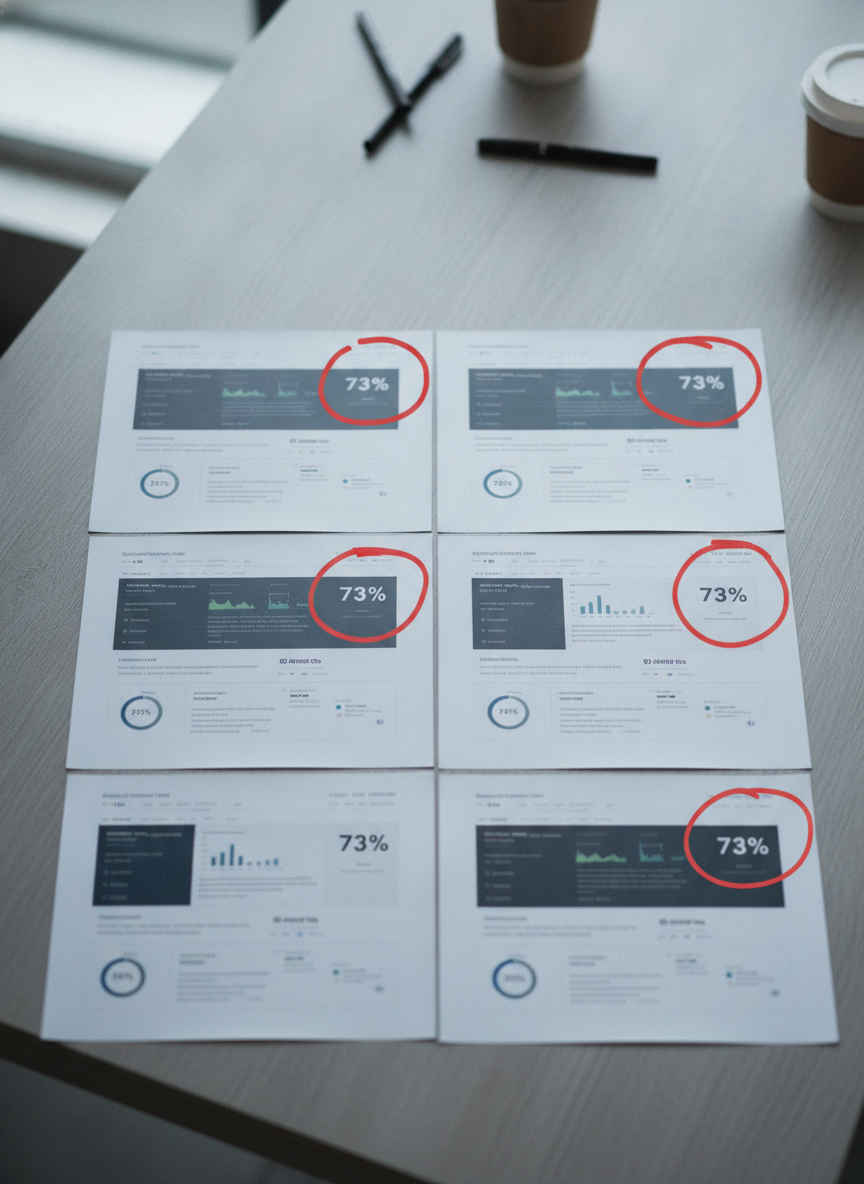
Read three case studies from the same agency back to back. If a roofing company in Rosenberg, a med spa in Richmond, and a law firm in Stafford all got the exact same "3x leads in 90 days" result written in the exact same language, something is off. Real projects have real variables: different starting points, different local competition, different seasons, different budgets. Genuine case studies read differently from each other, because real businesses are different from each other, with different problems that got solved in different ways. A template case study is built to be reused across industries and swapped with a new logo, not to accurately describe what actually happened to one specific client.
Identical results and wording across every case study usually means a template did the writing, not the data.
The "Results" Are Screenshots, Not Business Outcomes

A screenshot of a traffic graph trending upward looks convincing, but traffic is not revenue, and clicks are not calls. An agency can point to more website visitors while a client's actual phone rings less, if the wrong kind of traffic is coming in from the wrong searches. Ask what business outcome the case study is actually measuring, leads, booked jobs, or revenue, not just a dashboard that trends up and to the right. A trustworthy case study connects the design or marketing change to a business result you would genuinely care about, not a vanity metric that happens to be easy to screenshot and drop into a slide.
Rising traffic doesn't prove more leads or revenue, so ask what business outcome was actually measured.
A Glowing Quote Screenshot Isn't a Case Study

A glowing quote with a first name and a five-star rating is a testimonial, not a case study, and the two get blurred together constantly in agency portfolios. A testimonial tells you someone felt good about the experience. A case study tells you what specifically changed and by how much, with numbers you can check. Both have real value, but only one should ever be presented to you as proof of results. If an agency's "case studies" page is really just a wall of quote screenshots with no client names, no links, and no before-and-after numbers, you are looking at a testimonials page wearing a stronger label.
A testimonial proves someone felt good about the work; only real numbers and a named client prove it produced results.
Real, Named Proof
Honest proof is simple to build: name the client, link to their live site, and show the actual numbers, before and after, not just the multiplier. That is the standard behind every project on our proof page, and it is the same standard we hold our own web design work to before we ever publish it. Before you sign with any agency, ask for three things: the client's name, a link to the live result, and the raw numbers behind any percentage they quote. For the fuller picture on what separates agencies that deliver from ones that just look good in a pitch deck, read the biggest mistakes business owners make before hiring a web designer.
Ask For Proof
You've probably been sold a number before that turned out to be marketing, not proof, and that's exactly why you're reading this skeptically. Social Reach Co. only publishes results we can name, link, and stand behind, because a case study that can't survive five minutes of your own research isn't worth trusting. Ready to see real ones? Start a project or check out our proof page first.
Want to See Names, Not Just Numbers?
Every project on our proof page links to a real client and a real result, no anonymous percentages required. Prefer to talk it through first? Call 281-978-1847.
More from our blog
Explore strategies and insights for growing your brand
What partners say
Real results from people who trusted us with their business.
"From start to finish, their team demonstrated professionalism, expertise, and a genuine commitment to delivering top-notch results. Their innovative approach and attention to details set them apart from other companies..."
"Really happy with how my website turned out. They were so helpful in designing it to be exactly what my company needed. Great customer service, thank you! I'm a happy customer and highly recommend!"
FAQ
Common questions about content strategy and how Social Reach works
What kind of agency are you?
We’re a full-service marketing and design agency that covers both digital and physical touchpoints. That includes websites, SEO, and advertising, as well as printed materials like flyers, signage, and branded merchandise. Our goal is to make sure your business looks professional and consistent everywhere your customers interact with you—online and offline.
How do your services work together to grow my business?
We treat your website as the foundation, then build around it with marketing and design. Online, that might mean SEO, content, or ads to drive traffic. Offline, it includes branded materials that support your presence in the real world. When everything is aligned—your website, marketing, and print—it creates a stronger, more trustworthy brand that converts more customers.
Do I need both digital marketing and print materials?
It depends on your business, but many local and service-based companies benefit from both. Digital marketing helps people find you, while print materials reinforce your brand in person—whether that’s at events, in your storefront, or through direct outreach. We help you choose the right mix so you’re not overspending, but still making the biggest impact.
What services do you offer beyond website design?
In addition to building high-performing websites, we offer SEO, digital advertising, and content strategy to help drive traffic and leads. On the design side, we create everything from logos and brand assets to printed materials like brochures, signs, and merchandise. This allows us to support your business across every stage of growth.
Why should I work with one team for both digital and print?
Working with one team keeps everything consistent and strategic. When different vendors handle your website, marketing, and print materials, the messaging and design often become disconnected. We make sure everything—from your website to your flyers—feels cohesive and supports the same goal: building trust and bringing in more customers.
Let's build something that works
Schedule a call with us to discuss what you need to grow
{"@context":"https://schema.org","@graph":[{"@type":"BlogPosting","headline":"The Red Flags Hiding in Most Web Design Case Studies","description":"Before you hire a web design agency, learn the red flags hiding in vague case studies and portfolio claims, and what real proof actually looks like.","datePublished":"2026-08-20T00:00:00.000Z","author":{"@type":"Person","name":"LuzMarie Garcia"},"image":"https://cdn.prod.website-files.com/695e978db35c4de5af1f5a24/6a8726e1665c40fbd5316295_web-design-case-study-red-flags-main.png","url":"https://www.socialreachco.com/blog/web-design-case-study-red-flags"},{"@type":"FAQPage","mainEntity":[{"@type":"Question","name":"What's the biggest red flag in a web design case study?","acceptedAnswer":{"@type":"Answer","text":"A percentage increase with no starting number, like \"300% more leads\" with no mention of the original lead count. Without a baseline, that number is nearly impossible to verify and easy to inflate."}},{"@type":"Question","name":"How do I verify a web design agency's case study is real?","acceptedAnswer":{"@type":"Answer","text":"Search for the named client independently. You should find a working website, an active Google Business Profile, or a social presence that matches the story. If the client can't be found or isn't named at all, treat the case study as unverified."}},{"@type":"Question","name":"Why do some agencies avoid naming their case study clients?","acceptedAnswer":{"@type":"Answer","text":"Sometimes it's a legitimate confidentiality request from the client. More often, an unnamed \"client\" allows an agency to round up results, reuse language across projects, or present a composite story as a single real one."}},{"@type":"Question","name":"Are rising website traffic numbers proof that a web design project worked?","acceptedAnswer":{"@type":"Answer","text":"Not on their own. Traffic can increase while leads, calls, or revenue stay flat or drop. A trustworthy case study ties the design change to a business outcome, not just a chart trending upward."}},{"@type":"Question","name":"What should I ask an agency before hiring them based on a case study?","acceptedAnswer":{"@type":"Answer","text":"Ask for the client's name, a link to their live site, and the raw numbers behind any percentage claim. An agency confident in its results should be able to answer all three without hesitation."}}]}]}